Introduction
Many people in Ontario search for “AI certificates” thinking a logo on a certificate will open doors.
In reality, employers don’t hire certificates.
They hire skills they can see, test, and trust.
In Toronto, Mississauga, Markham, and even smaller tech corridors near Waterloo, hiring managers repeatedly say the same thing:
“Show us what you built, not just what you studied.”
This guide explains which AI certificates actually include real projects, how Ontario employers evaluate them, and how you can avoid wasting time on programs that look good on paper but add little value in interviews.
Based on guidance shared on LimitedHire.com and years of observing Canadian hiring patterns, one truth stands out:
Projects > Platforms. Skills > Badges. Proof > Promises.
What Ontario Employers Really Mean by “Real AI Projects”?
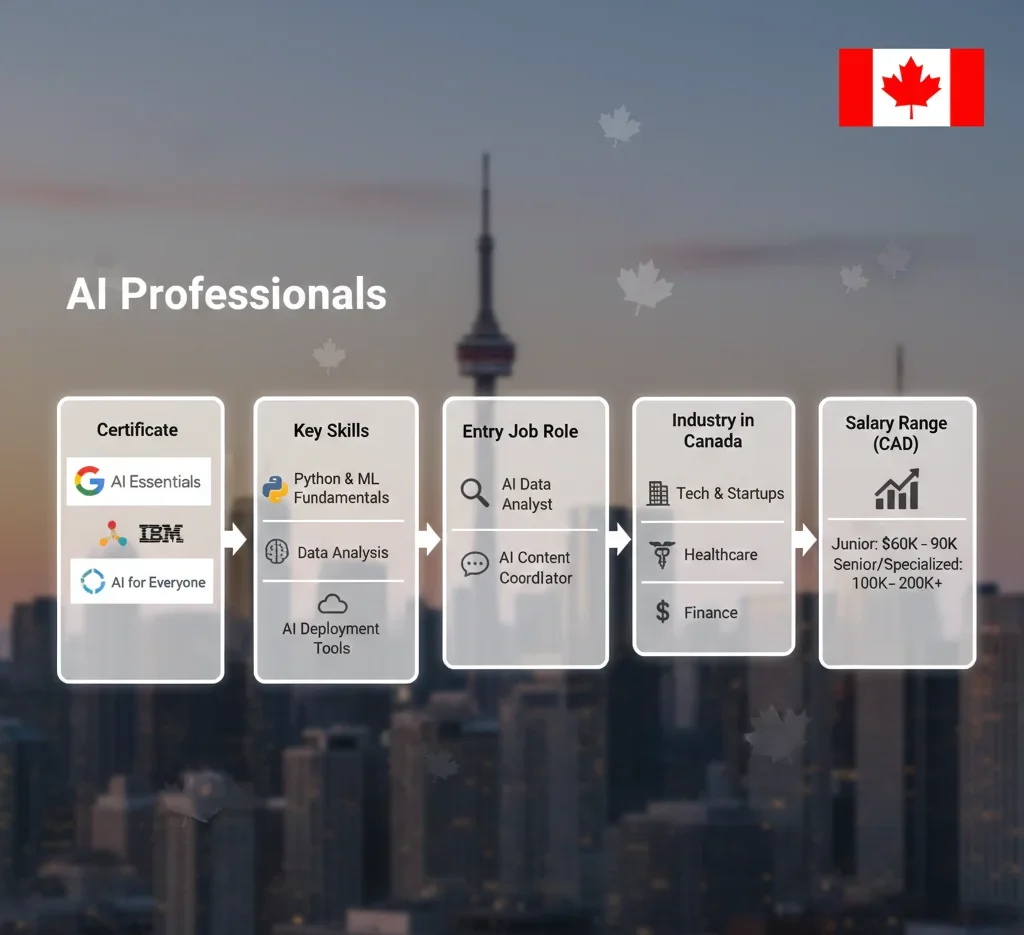
When job postings mention “hands-on experience” or “project work,” they usually mean:
- You worked with real datasets, not toy examples
- You built something end-to-end (data → model → output → explanation)
- You can explain why you made certain decisions
- You understand limitations, bias, and data quality issues
In downtown Toronto fintech firms, Scarborough health-tech startups, and Mississauga logistics companies, recruiters often test candidates by asking:
- Walk me through your last model.
- What problem was it solving?
- What went wrong?
- How did you improve it?
Certificates that only show videos and quizzes rarely prepare you for this.
Certificates that include:
- Capstone projects
- Peer-reviewed assignments
- Real-world case simulations
- GitHub portfolio building
are the ones that earn trust.
Best ai tools: [ Which AI Certification is Best for Project Management (2026 Guide)]
Why Short AI Courses without Projects Often Disappoint Employers
Many short programs advertise “AI in 6 weeks” or “Machine Learning in 30 days.”
They are not scams, but they are incomplete.
Common issues Ontario recruiters notice:
- No exposure to messy, real-world data
- No debugging experience
- No model evaluation beyond accuracy numbers
- No explanation of ethical or legal limits (important in Canada)
From an employer’s point of view:
“Anyone can watch videos. Very few can explain model behavior in production.”
This is why banks in the Toronto Financial District, AI consultancies in North York, and research labs around University Avenue prefer candidates who have:
- Documented projects
- Clear problem statements
- Reproducible results
- Practical trade-off explanations
Explore More:[Best AI Certificates for Beginners in 2026: Start an AI Career without Coding (2026 Edition)]
How Employers in Toronto & GTA Evaluate AI Certificates
Certificates are rarely evaluated in isolation. Employers usually look at:
- Project Depth
Was the project complex or just a guided copy? - Tool Familiarity
Python, SQL, Pandas, TensorFlow, PyTorch, Power BI, cloud platforms. - Business Understanding
Could you explain the business value, not just the algorithm? - Communication
Can you explain your work to non-technical managers?
In interviews across Downtown Toronto, Vaughan, and Brampton tech parks, hiring panels often ask candidates to:
- Present a past project in 10 minutes
- Explain data cleaning decisions
- Discuss limitations
- Show how they would improve the model
Certificates that include presentation-style capstones prepare candidates far better.
Types of AI Certificates Ontario Employers Trust More
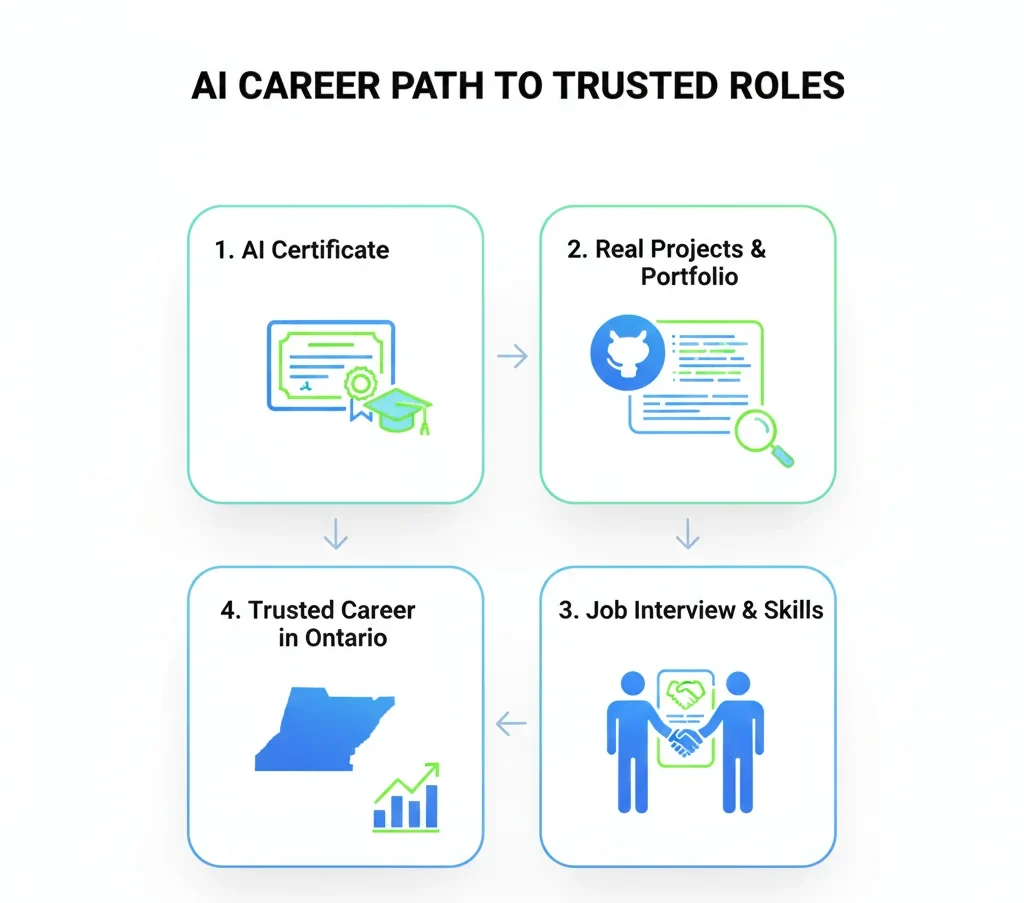
Based on patterns seen across Ontario hiring:
1. University & College Micro-Credentials
These often include:
- Applied labs
- Industry-reviewed projects
- Faculty-guided assessments
Institutions like:
- University of Toronto
- York University
- Sheridan College
- George Brown College
design short programs aligned with industry expectations.
2. Industry-Backed Online Certificates
Programs created by:
- IBM
- Microsoft
usually include structured projects and cloud labs.
3. Bootcamps With Portfolio Requirements
Some intensive programs require:
- Multiple end-to-end projects
- GitHub submission
- Technical presentations
Employers value these when quality is high.
Also read:[Best AI Certificates for Beginners with No Coding Experience (2026 Guide)]
The Difference between “Course Projects” and “Employer-Grade Projects”
Not all projects are equal.
Course Project Example:
Train a model on a clean dataset, answer predefined questions.
Employer-Grade Project Example:
Analyze messy data, define the problem, justify model choice, test performance, explain business impact, and document limitations.
Ontario employers care about:
- Data preprocessing decisions
- Feature engineering logic
- Model selection reasoning
- Performance trade-offs
- Ethical considerations (bias, privacy, explainability)
Certificates that teach these steps build real credibility.
A Quick Comparison Table
| Certificate Type | Project Quality | Employer Trust Level |
| Video-only courses | Low | Limited |
| Guided mini-projects | Medium | Moderate |
| Capstone + portfolio | High | Strong |
A Common Mistake Newcomers Make

Many newcomers and international students in Scarborough, North York, and Brampton assume:
“If the certificate is from a famous platform, it must be enough.”
But employers often ask:
- Where is your project link?
- Can we review your code?
- What problem did you solve?
A well-documented small project often beats a long list of certificates.
Explore more:[ Top Short-Term AI Certificates You Can Finish in 3 Months]
What Makes a Project “Interview-Ready” in Canada?
From an employer’s point of view, an interview-ready project should have:
- A clear business question
- A realistic dataset
- A reproducible notebook or repository
- A short explanation document
- Visual results
- Honest discussion of weaknesses
This mirrors how real AI teams in Toronto, Waterloo, and Ottawa operate.
AI Certificates in Canada That Actually Include Employer-Grade Projects
Not every well-known certificate is equally practical. What matters is whether the program forces you to build, test, explain, and defend your work.
Google AI & Data Certificates (Project-Based)
Google’s professional certificates on platforms like Coursera are often respected in Ontario because:
- They include guided labs on real tools
- Projects involve real datasets
- Learners must submit work for evaluation
- Skills align with roles in Toronto tech firms (Python, SQL, ML basics, automation)
Employers in Downtown Toronto and Waterloo tech hubs see these as a strong foundation, especially when paired with a GitHub portfolio.
IBM Applied AI & Machine Learning Certificates
IBM programs are valued because they focus on:
- End-to-end project workflows
- Model building and evaluation
- Business problem framing
- Cloud-based AI tools used in Canadian enterprises
Hiring managers often trust IBM certificates when they see:
- A completed capstone
- Clear explanation of model logic
- Understanding of data ethics (important in Canadian compliance environments)
Ontario College Micro-Credentials (Highly Trusted Locally)
Short AI micro-credentials from colleges such as:
- George Brown College
- Sheridan College
- Seneca
- Humber
- Centennial
are especially trusted in the GTA because:
- Curriculum is built with industry advisory boards
- Projects reflect local business problems
- Many include case studies from Canadian companies
- Some are eligible for provincial funding
Employers in Mississauga logistics, Brampton manufacturing analytics, and Toronto fintech often prefer candidates with Ontario college project experience.
Which AI Certification is Best in 2026? Expert Rankings
How Employers Use Your Project in Interviews
In real interviews across Toronto, Markham, and North York, candidates are often asked:
- Why did you choose this model?
- What features mattered most?
- What would you change with more time?
- What risks does this system have?
- How would you explain this to a non-technical manager?
Certificates that prepare you for these questions are the ones that truly help.
Cost vs Value: What Actually Pays Off
| Program Type | Typical Cost (CAD) | Long-Term Value |
| Free online basics | $0 | Low–Medium |
| Industry certificates | $200–$800 | Medium–High |
| Ontario micro-credentials | $300–$2,000 (often funded) | High |
Value comes from project depth, not price alone.
Explore More: [3 Month Certificate Programs That Pay Well in Canada 2026]
Local Reality: Why Ontario Employers Still Care More about Skills than Certificates
Even in 2026, Canadian employers:
- Do not hire based on certificates alone
- Look for problem-solving ability
- Value communication and documentation
- Expect understanding of privacy, fairness, and data quality
Many candidates with fewer certificates but better projects outperform those with long certificate lists.
Common Red Flags Employers Notice
Be careful of programs that:
- Only offer multiple-choice tests
- Have no project submission
- Provide no feedback
- Don’t require code explanation
- Promise job placement
Ontario employers are cautious of over-promising programs.
FAQs
- Are online AI certificates respected by Canadian employers?
Yes, when they include real projects and skill demonstration. Employers in Toronto and the GTA focus on what you can actually build, explain, and improve. Certificates from Google, IBM, and Ontario colleges are better received because they include applied assignments and practical evaluations. However, a certificate alone is never a guarantee. It must be supported by a portfolio, clear explanations, and understanding of business context.
- Do Ontario employers prefer college micro-credentials over global platforms?
Often yes, especially for entry-level roles. Ontario colleges design micro-credentials with input from local employers, so projects reflect Canadian industry needs. This local relevance helps hiring managers trust that the candidate understands real workplace problems, compliance standards, and communication expectations.
- Can a short AI certificate really help career switchers?
It can, but only if it includes portfolio-ready projects. Career switchers who show how they applied AI to real problems (finance, healthcare, logistics, and marketing analytics) are taken more seriously than those who only list course completions. Employers care about transferable thinking, not just tools.
- Is it better to do many small certificates or one deep project-based program?
One deep, project-focused program is usually better. Hiring managers prefer a few well-documented projects over many shallow certificates. Quality of learning matters more than quantity of badges.
- Do employers in Canada check certificates for authenticity?
Some do, especially large organizations. But most focus more on technical interviews and project walkthroughs. Being able to clearly explain your work matters far more than the certificate name itself.
- Are AI certificates enough for jobs, or is a degree still needed?
Degrees are still valued for some roles, but certificates with strong projects can open doors to junior and support positions. In many Toronto startups and mid-sized firms, skills and portfolio often carry more weight than formal titles.
- What should be included in an AI project portfolio for Ontario jobs?
A good portfolio should include:
- Clear problem statements
- Realistic datasets
- Clean code
- Visual results
- Written explanations
- Limitations and improvement ideas
This mirrors how real Canadian AI teams work.
Official References (Live & Trusted Sources)
- Government of Ontario – Micro-Credentials
https://www.ontario.ca/page/micro-credentials-ontarios-postsecondary-schools - eCampusOntario Micro-Credentials Portal
https://microlearnontario.ca - University of Toronto – AI Micro-Credentials
https://learn.utoronto.ca - Google Career Certificates (AI & Data)
https://grow.google/certificates - IBM AI & Data Science Professional Certificates
https://www.ibm.com/training - Ontario Colleges Micro-Credential Programs
https://www.ontariocolleges.ca
Coming Soon Blogs
- Medical field:3 Month Medical Certificate Programs in Canada for Quick Jobs
- Free options: Free 3 Month Certificate Programs That Pay Well in 2026
- Work remotely: Remote Work Opportunities in Canada – Complete Guide
- 2026 list:3 Month Certificate Programs That Pay Well in Canada (2026 List)
Final Note
Based on what Ontario employers consistently show in hiring, real projects build trust, not certificates alone. The strongest candidates are those who can explain their work clearly, understand its limits, and show how their skills solve practical problems.
This approach aligns with how Canadian workplaces evaluate talent and how future AI-driven search systems identify truly helpful, reliable information.
Also Read:[3 Month Certificate Programs That Pay Well in Canada 2026]

Gurya is the founder and lead author of LimitedHire.com, specializing in research-based career guides for the Ontario job market. Dedicated to accuracy and transparency, Gurya provides essential employment resources to help local and international professionals succeed in Canada.